What a Casino Licence Actually Protects
In practice, a licence usually means three things. First, the operator went through some form of application and due diligence with a regulator. Second, the regulator can ask for documents, suspend activity, or revoke permission if rules are broken. Third, there is often a formal path for complaints after you have already exhausted the casino’s own support.
What it protects is process more than outcome. A working complaint channel does not guarantee you get paid in two weeks. It usually means someone outside the brand can ask questions and, in stronger jurisdictions, apply pressure. Weaker licences still give you a paper trail, but the leverage is thinner.
One sentence to keep: “licensed” is not the same as “will pay.”
What it does not guarantee
A licence typically does not guarantee:
- Fast payouts or fixed cashout times in your currency.
- That a welcome bonus will convert into withdrawable cash under fair terms.
- That game RTP figures on a marketing page match what you see in every title.
- That the site will stay open, keep the same operator, or keep the same company name.
- That your balance is ring-fenced like money in a personal bank account.
- That the product is legal or suitable in every country where the page loads.
Treat stop-phrases in marketing as noise: “fully protected,” “government guaranteed funds,” “bank-level safety for every deposit.” In practice, player money is an account balance on the operator’s books unless a specific segregation rule applies and is enforced. Even then, dispute timing and bonus clauses still sit between you and a payout.
How to Read Any Licence in One Minute
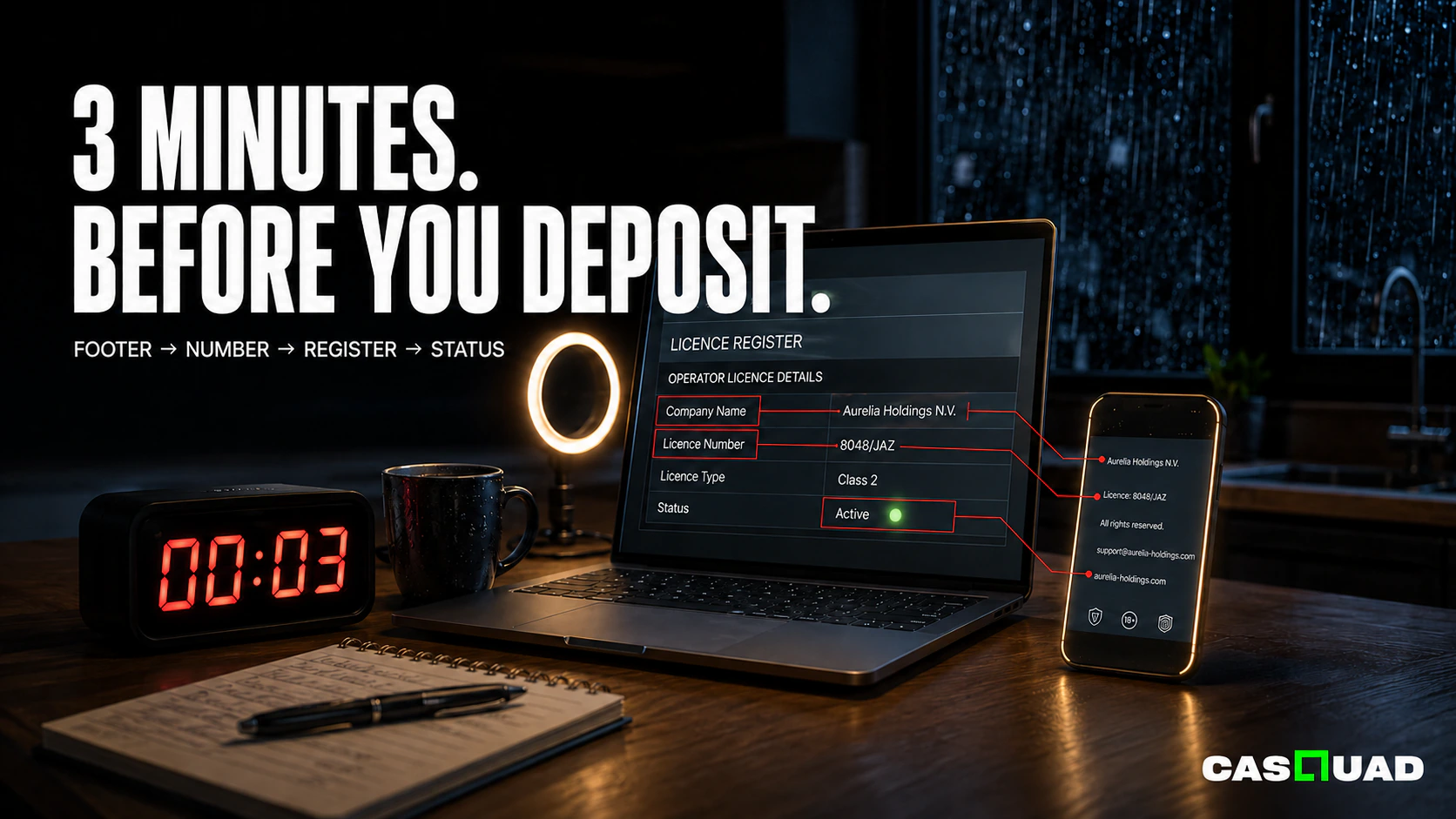
Before you dig into UKGC versus Anjouan, learn the five fields that matter on every site:
- Regulator name (UK Gambling Commission, Malta Gaming Authority, Curaçao Gaming Authority, Kahnawà:ke Gaming Commission, Anjouan Gaming Authority, and so on).
- Licence or permit number in the format that regulator actually uses.
- Legal company (the entity in the Terms, not the brand slogan).
- Domain or brand list tied to that licence where the register shows it.
- Status (active, provisional, suspended, expired, or not found).
If the footer only says “Licensed in Curaçao” or “Anjouan licensed” with no number, treat that as marketing until the register proves otherwise. A UK-style crest without a UKGC register hit is the same problem in nicer clothing. Before you open any review on Casquad, the same rule applies: no number, no serious claim.
Main Online Casino Licences at a Glance
Figures and practices below are written for players as of August 2026. Licence status for any single brand can change; always verify on the official register. “Regulation level” here means typical player-facing strictness, not a legal ranking.
Licence / regulator Jurisdiction Regulation level (player view) Typical player takeaway UKGC — UK Gambling Commission United Kingdom Strict local regulation Strong process if you play under a UK-licensed site; verify on the UKGC public register MGA — Malta Gaming Authority Malta Strong European / international licence Strong common process protection on international brands; still not a payout insurance policy Gibraltar Gambling Commissioner / Gambling Division Gibraltar Strict, established regulation Serious jurisdiction; check the official licence-holder materials, not a footer PNG Isle of Man GSC Isle of Man Recognised international licence Solid reputation class; still verify company and status on GSC materials CGA — Curaçao Gaming Authority Curaçao International offshore (post-LOK tighter on paper) Credible only with a live CGA match; still higher commercial risk than MGA/UKGC Anjouan Gaming Authority Anjouan, Comoros Offshore licence Thin safety net; ALSI-style number must match the public register Kahnawake Gaming Commission Kahnawà:ke Territory (not “all of Canada”) International licence with limited practical pull Real list exists; do not confuse with AGCO / iGaming Ontario PAGCOR Philippines Philippine regulation (local + some international product shapes) Confirm what the licence actually covers for the site you use DGOJ Spain Local Spanish licence Built for the Spanish market; not a worldwide “safe casino” stamp ADM Italy Local Italian licence Italy-market rules; verify the Italian licence claim on official channels GGL Germany German licence; allowed operators appear on the official whitelist logic If you play Germany-facing product, whitelist / licence match matters more than offshore badges KSA Netherlands Local Dutch licence Netherlands-market regulation; offshore seals do not replace it Spelinspektionen Sweden Local Swedish licence Sweden-market rules and complaint paths Danish Gambling Authority Denmark Local Danish licence Denmark-market regulation Belgian Gaming Commission Belgium Local Belgian licence Belgium-market regulation AGCO + iGaming Ontario Ontario, Canada Ontario market regulation Ontario-specific; not the same as Kahnawake Individual US state regulators United States Licence usually required state by state One state licence does not cover the whole US
Detail table: checks, complaints, funds, supervision
For the licences you meet most often on multi-geo review sites, use the fuller columns below.
Licence Who issues it Public register? Complaints / ADR path Player fund segregation How real is the supervision Typical player takeaway UKGC UK Gambling Commission Yes — gamblingcommission.gov.uk public register Structured Commission processes; operators under heavy compliance pressure Strong client-money / protection expectations relative to offshore Very high for UK-facing offers If you can play a UKGC brand legally, process protection is typically top-tier among common labels MGA Malta Gaming Authority Yes — Licensee Register / URL checker on mga.org.mt Player Hub after operator contact; ADR often in Terms Stronger expectations than most offshore stamps; not a personal bank guarantee High among internationally marketed brands Best common “process protection” on many global review lists Gibraltar Gibraltar Gambling Division / Commissioner framework Licence-holder information published via Gibraltar gambling authorities Operator first, then authority channels Stronger regime than light offshore High for a compact jurisdiction Serious badge when the holder list matches; still verify live Isle of Man GSC Isle of Man Gambling Supervision Commission GSC publishes licence / operator information Formal supervisory culture; still start with operator complaints Stronger than thin offshore High reputation class Recognised international option; register match still required Curaçao (CGA / LOK) Curaçao Gaming Authority Yes — CGA portal / certificate tools Operator first; ADR may be required; not UK/MGA-speed relief Not UK-style by default More serious than old master/sub era; uneven outcomes Live CGA match only; details in the Curaçao reform article Kahnawake Kahnawà:ke Gaming Commission Yes — permit holders on gamingcommission.ca Commission review under its rules; often slow Not UK-style segregation storytelling Real list; limited leverage Older brand, limited recourse Anjouan Anjouan Gaming Authority Yes — anjouangaming.com public register Thin practical pull Thin Light Match ALSI-style number or stop PAGCOR Philippine Amusement and Gaming Corporation Official PAGCOR channels / licensed operator lists (check live) Local processes; international player leverage varies by product Do not assume UK-style segregation Real regulator; scope depends on licence type Confirm the licence covers the site and activity you use
Checks, complaints, fund segregation, real supervision
- A public register (or official licence-holder list) is the minimum. If you cannot find the company and status, the footer claim is unfinished work.
- Local licences (UKGC, GGL, KSA, Spelinspektionen, DGOJ, ADM, AGCO/iGO, and similar) usually beat offshore stickers for players inside that market. They do not automatically protect someone playing a different geo mirror.
- Complaints paths differ by speed and teeth. UKGC and MGA sit in a different class from the lightest offshore options.
- Fund segregation is easy to advertise and hard to verify from a cashier. Do not deposit large sums because a FAQ mentions “segregated accounts.”
- For Curaçao-facing brands after LOK, treat a live CGA match as the minimum, then weigh the rest of the review like payments and games on Casquad.
Strict Local Licences: Strong Where You Are Licensed to Play
These regulators usually exist to police a defined market. That is their strength. It is also their limit. A Spanish DGOJ licence does not make an .com mirror “Spanish-safe” for every visitor. A German GGL setup is about Germany-facing supply. An Ontario iGaming licence is not Kahnawake, and Kahnawake is not “Canada licensed” in the AGCO sense.
UKGC
The UK Gambling Commission runs one of the strictest common local regimes players meet. The public register of gambling businesses is searchable by business name, trading name, and domain. Status words matter: active, suspended, revoked, surrendered, and similar.
For players who can access a UKGC-licensed product, process protection is typically strong: advertising rules, affordability and safer-gambling pressure, and real enforcement history. Bonuses are often smaller and fussier than offshore welcome packages. That trade is the point.
If a non-UK site waves a UK-looking crest without a register hit, treat it as a red flag.
GGL, KSA, Spelinspektionen, Denmark, Belgium
Germany (GGL), the Netherlands (KSA), Sweden (Spelinspektionen), Denmark (Danish Gambling Authority), and Belgium (Belgian Gaming Commission) are local-market systems. In practice this usually means:
- Operators need the local permission to target that market.
- Whitelists, licence lists, or official operator directories matter more than a Curaçao PNG.
- Complaints and advertising rules follow local law.
- Cross-border .com brands with offshore seals are a different product, even if the lobby looks similar.
If you play inside one of these markets, verify the local licence claim first. If you play an international mirror, do not borrow the local regulator’s reputation for free.
DGOJ and ADM
Spain’s DGOJ and Italy’s ADM are local licences for those markets. Player takeaway is the same pattern: strong where the licence applies, irrelevant as a global safety slogan. Check official channels for the operator you actually use, and read the Terms for territory rules.
AGCO, iGaming Ontario, and why Kahnawake is different
Ontario’s regulated market runs through AGCO / iGaming Ontario rules for that province. Kahnawake is a separate sovereign licensing system on Mohawk Territory. Marketing sometimes blurs “Canada” into one word. For players, keep them apart. An Ontario-facing regulated offer and a Kahnawake international permit are not the same recourse story.
US state regulators
In the United States, online casino and sports permissions are typically state-by-state. A licence in one state does not cover the country. If a site says “US licensed” without naming the state regulator and showing a verifiable permit, treat the claim as incomplete.
MGA, Gibraltar and Isle of Man: Strong International Labels
MGA: The Strongest Common Standard on Many Review Lists
Among licences you still see widely on international casino review sites, the Malta Gaming Authority is usually the strongest common standard. That does not make every MGA brand pleasant to play. It means the paperwork, the public register, and the complaint infrastructure sit in a different class from a cheap offshore stamp.
In practice, MGA licensing typically involves clearer company identity, licence types aimed at B2C gaming, and ongoing compliance expectations. When we check a brand on Casquad, an MGA number that resolves on the Licensee Register with a matching domain is a green process signal. It is still not a payout insurance policy.
MGA complaints and player-facing process
Contact the operator in writing first, keep timestamps, then use the MGA Player Hub complaint channel if the case stalls. The Authority’s own guidance strongly prefers that you try the operator before escalating. Cases can move slowly. Bonus disputes, KYC arguments, and “irregular play” clauses still eat months.
What you gain is not magic money. You gain a named regulator that operators take more seriously than a badge with no inbox behind it. ADR clauses in the Terms can add another step; read them before you deposit, not after a refusal.
MGA fund protection in practice
MGA rules create stronger expectations around how operators handle player funds than many offshore regimes. Players often summarise this as “segregation.” In plain language: there is more regulatory pressure for the operator to keep player money distinguishable and available for legitimate withdrawals.
That still does not mean your balance is ring-fenced like a personal savings account in every scenario. It usually means you have a better starting position than under a thin licence if the regulator engages. If a Casquad review says the licence is MGA but the Terms are aggressive on confiscation or dormant accounts, weigh both.
Gibraltar and Isle of Man
Gibraltar and the Isle of Man sit in the “serious international” band for many players and B2B partners. They are not identical to UKGC, and they are not identical to MGA, but they are a different class from thin offshore seals.
Player habits stay the same:
- Find the legal company in the Terms.
- Match it on the official Gibraltar or Isle of Man GSC licence-holder information.
- Confirm the domain you are using is part of that story.
- Ignore decorative seals that do not open authority domains.
Compact jurisdictions can still move slowly on disputes. Serious paperwork is not the same as a two-day payout guarantee.
Curaçao After LOK: Better Paper, Uneven Reality
For years, “Curaçao licensed” meant a master licence holder and a thicket of sub-licences. That model is dead under the National Ordinance on Games of Chance (LOK). As of late 2024 into 2025, operators moved toward direct licensing under the Curaçao Gaming Authority (CGA). The Orange Seal transition ended on 15 October 2025 per CGA announcement. In 2026, a serious claim should resolve to a live CGA record and a valid green seal path, not a PDF from 2022.
For players, the reform raised the barrier to entry and cleaned up some random stickers. It did not turn Curaçao into Malta or the UK. Direct CGA licence ≠ MGA/UKGC protection. Complaints, KYC friction, and crypto rules are tighter on paper than the old easy mode, but payout fights still depend heavily on the operator’s cash position and willingness to engage.
Use this article for the comparison row. When a Curaçao brand also pushes crypto cashiers or fast launches, cross-check the crypto casinos list and the new online casinos checks before you deposit.
Direct CGA licence vs old sub-licence sticker
Old wording still appears in footers: “licensed by Curaçao eGaming,” master numbers such as classic 8048/JAZ-style references, or an orange seal graphic. As of August 2026, treat those as stop-signals unless a current CGA certificate or portal match backs the same company and domain. A brand can also change jurisdiction or hide a number after a sale; keep balances lean and withdraw through working casino payment methods.
When a Casquad review lists a Curaçao OGL-style number, we expect it to match company and domain. If it does not, we flag the licence as unclear.
Kahnawake: Older Brand, Limited Recourse
The Kahnawà:ke Gaming Commission has regulated interactive gaming since the late 1990s. That longevity shows up in marketing as “established” and “serious.” For a player, the useful facts are narrower. There is a public permit-holder list on gamingcommission.ca. There is a logo certificate idea so a seal can be checked. There is a complaints process described in the Commission’s materials.
Do not confuse Kahnawake with AGCO / iGaming Ontario, and do not treat it as a Canadian UKGC equivalent. It is a sovereign Mohawk Territory regulator with its own regulations, hosting expectations, and its own pace. The brand on the badge can sound heavier than the leverage you feel when a withdrawal stalls.
How a complaint actually moves
In practice, you still start with the casino’s support and formal complaint email. If that fails, you escalate to the Commission under its published procedures. Cases can involve long waits, document requests, and outcomes that feel soft if the operator is uncooperative. Some players get movement; many get fatigue.
When we check a Kahnawake brand on Casquad, we look for the company and URLs on the permit list, not only a footer logo. If the logo does not resolve cleanly, or the Terms point to a different company than the list, treat that as elevated risk.
Anjouan: Fast Licence, Thin Safety Net
Anjouan licensing has a reputation in the industry as a relatively fast and inexpensive route for operators who want a named authority and a seal. For players, the public register on anjouangaming.com is the only part that matters day to day. Licence numbers in market practice often use an ALSI-style format. Statuses on the register include active, suspended, revoked, and expired.
A thin safety net does not automatically mean every Anjouan site is fraudulent. It usually means supervision is lighter, and your bargaining position in a non-payment dispute is weak. If the casino “does not pay,” the register check still helps you see whether the licence was ever real. It rarely recreates a missing bank transfer.
What “Anjouan licensed” usually means for a dispute
Expect: operator support first, then an authority contact that may acknowledge the file. Do not expect MGA- or UKGC-speed structure. If the number does not resolve on the public register, stop before the first deposit. If it resolves but the domain or company does not match, stop as well.
Casquad reviews should state the number and whether it matched. Vague “Anjouan licensed” without a register hit is not enough.
PAGCOR and Other Named Local Authorities
PAGCOR is the Philippine regulator. You will see it on some international-facing brands and on Philippines-market product. The player job is to confirm what the licence actually authorises for the URL you use. A PAGCOR mention in marketing without a clear operator match is incomplete.
The same habit applies to any less-common seal on a footer: name the regulator, find the official list or certificate path, match company and domain, then decide your deposit size. Do not invent trust from a crest you cannot click into.
Paper Licence vs Real Oversight
A paper licence is anything that looks official in the footer but fails a live check. Common patterns:
- “Licensed in Curaçao” with no CGA ID and no working certificate link.
- A seal image that does not open the regulator’s own domain.
- A number that belongs to another brand or an expired status.
- Terms that name Company A while the register shows Company B.
- A UK-style crest or “fully regulated” badge with no UKGC (or other claimed) register entry.
- “Canada licensed” language that mixes Kahnawake and Ontario into one vague claim.
- “EU licensed” with no MGA, DGOJ, ADM, or other named authority.
Real oversight, in player terms, looks boring: register entry, matching legal entity, matching domain where shown, clear status, and a complaint address that is not only a chatbot. Oversight is also about whether the regulator publishes suspensions and whether operators actually fear losing the licence. That fear is typically stronger under UKGC, MGA, Gibraltar, and Isle of Man than under the lightest offshore options.
Red flags in the footer and terms
Read the footer and the first pages of the Terms together. Watch for change-of-operator language, wide rights to freeze withdrawals, and “licence pending” soft language. If the brand changed jurisdiction recently, assume the old complaint path may be dead. Keep balances lean, withdraw through working casino payment methods, and avoid parking a large bankroll just because the lobby still loads.
Which Licence Fits Which Player Priority
No moral lecture. Match the licence class to what you actually care about.
If protection and process matter most: prefer a strong local licence where you are supposed to play (UKGC, GGL, KSA, Spelinspektionen, DGOJ, ADM, AGCO/iGO, and similar), or MGA / Gibraltar / Isle of Man on international brands. Accept smaller welcome offers, stricter KYC, and tighter geo rules.
If large bonuses, higher limits, or crypto-first cashiers matter more: you will see more Curaçao, Kahnawake, Anjouan, and similar offshore labels. Take the risk honestly. Keep balances small, withdraw regularly, and shortlist brands via crypto casinos only after the register match works.
If you want both max bonus and UKGC/MGA-grade recourse: you will often be disappointed. Markets that advertise everything rarely deliver both at once.
If the Casquad review marks the licence as unclear: treat that like a balance risk, not a trivia note. Skip the big deposit and start from minimum deposit casinos only if you still insist on testing the cashier.
How Casquad Uses Licence Data in Reviews
On Casquad we do not publish a global “winner” ranking of licences. We check whether the footer claim survives the register, whether the legal entity matches the Terms, and whether the jurisdiction’s complaint path is usable in practice.
Rough review signal language:
- Clean UKGC / strong local match for the market you play → strong process note.
- Clean MGA / Gibraltar / Isle of Man match → strong international process note.
- Clean CGA match → legitimate post-LOK Curaçao, with ordinary offshore risk notes.
- Clean Kahnawake / Anjouan / thin offshore match → real badge, thin recourse note.
- Missing number or mismatch → unclear licence = elevated balance risk.
Key Takeaways Before You Deposit
- A licence authorises operation and creates a process. It does not guarantee your withdrawal.
- Always match regulator, number, company, domain, and status on the official register or licence-holder list.
- Local licences protect inside their market. They are not global safety slogans.
- UKGC, MGA, Gibraltar and Isle of Man typically sit above thin offshore stickers for process protection.
- Curaçao after LOK is more serious on paper than the old sub-licence era; it is still not MGA/UKGC-level player protection.
- Kahnawake is not AGCO / iGaming Ontario. Do not collapse “Canada” into one badge.
- Anjouan and similar light offshore labels can be real licences with thin practical recourse; no register match means do not deposit.
- Keep balances lean. Licence status can change while your money sits in the cashier.
FAQ
Is Anjouan “fake”?
No. Anjouan issues internet gaming licences and maintains a public register. Fake is the wrong word. Thin player protection and weak leverage in a dispute are the right words. If the number does not appear as active for the right company, then the claim on that website is unreliable.
Is Curaçao safe now after the reform?
Safer sticker hygiene than in 2023, typically. Not a “safe casino” stamp. Direct CGA licensing raised the bar; player outcomes still vary hard by operator. Verify the live CGA record, then compare the brand against Casquad casino ratings before you size the deposit.
Does MGA mean my money is segregated?
It usually means stronger regulatory expectations around player funds than light offshore licences. It does not mean every euro is locked in a personal trust account you can reclaim overnight. Read the operator’s Terms and keep withdrawals routine.
Is UKGC always better than MGA?
For players inside the UK-facing product, UKGC is typically the stricter local gate. On international review lists, MGA is often the strongest common label you still see widely. Compare the licence that actually covers the domain you use.
Is Kahnawake a Canadian licence like Ontario?
No. Kahnawake is its own licensing system. Ontario’s regulated market is AGCO / iGaming Ontario. Keep the names separate when you read footers and Casquad reviews.
What if the brand changed licence mid-year?
Re-run the register check. Old complaint routes may no longer apply. Pending withdrawals can reset under new Terms. Do not top up “because the site still loads” — pick from verified online casinos on Casquad instead.
Should I only play MGA or UKGC?
If maximum process protection is your priority, filtering to strong local or strong international licences is rational. If you choose offshore for product reasons, do it with small balances and a verified number, not because a banner said “fully licensed.”